Subhayan Bhattacharyya
On the second day in Praslin, we woke up early with the prospects of exploring the two of the most beautiful sites in Praslin. One of them was the beach called Anse Goergette and the other being a nature park named Vallee de Mai.
We started early morning towards the beach as we wanted to feel the serenity of the place, assuming that the place would be less crowded at that time of the day. On the way we saw a road sign board indicating towards Petite Anse Kerlan. We looked at each other and made a grin and we knew we should go there before we head to Anse Georgette. We had heard about Anse Kerlan from our fellow travellers the day before. The beautiful scenery, including a small offshore island, rocky formations, golden sand, and looming palm trees, makes Petite Anse Kerlan a pleasant place to spend some time. It serves as a worthy prelude to Anse Georgette.
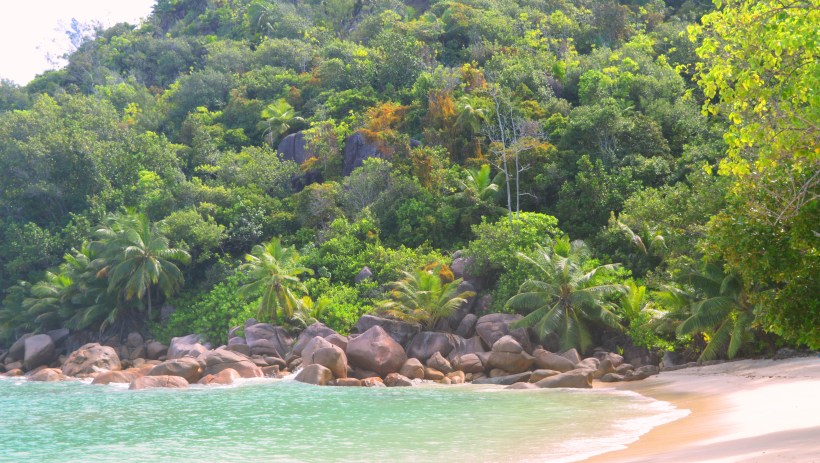
After dawdling on the pink sand at Anse Kerlan for half an hour we headed towards Anse Georgette. Anse Georgette is a stunning beach framed by granite boulders and offers powder soft white sand. Getting to the beach is especially simple for guests of the Lemuria Resort. The hotel offers golf-cart transfers to Anse Georgette on a frequent basis. For non-guests, you should inform the hotel of your visit, then you must make the 30-minute walk down to the beach yourself.
Once you reach the beach, it’s easy to see why people often claim Anse Georgette to be the most beautiful beach in Praslin. The incredible scenery is world-class, with few beaches elsewhere being able to claim such turquoise ocean and perfect white sand. Far from just being an eye-candy, Anse Georgette offers beautiful water for bathing and snorkelling. The water does get deep rather quickly, as there is no protection from an offshore coral reef, so children and unconfident swimmers should always be supervised in the water. The beach is ideal for photographers, with the view from the top of the hill serving as a real highlight of any Seychelles holiday.
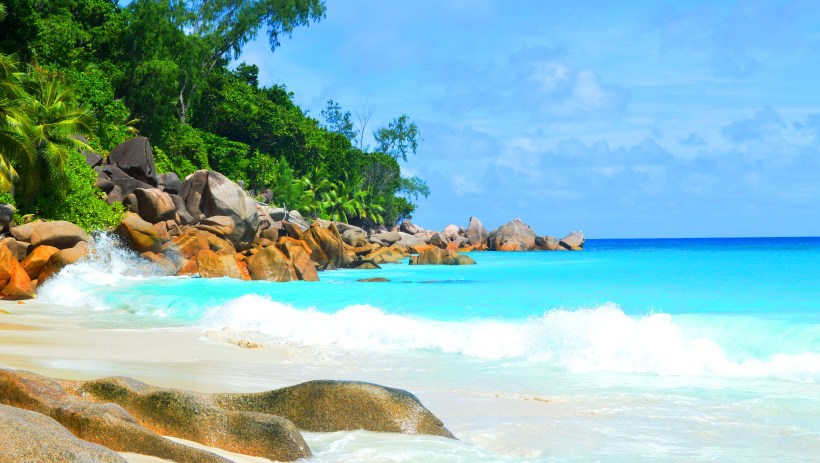
Anse Georgette is one of the few ‘untouched’ beaches in the Seychelles, offering astounding natural beauty. With so many positives, it’s easy to see why the beach is so popular, and guests come from all over the island to enjoy this incredible spot, making it a real must-see for any Seychelles traveller. After that for lunch we headed to Britannia Restaurant. It is located on the way to Vallee de Mai.
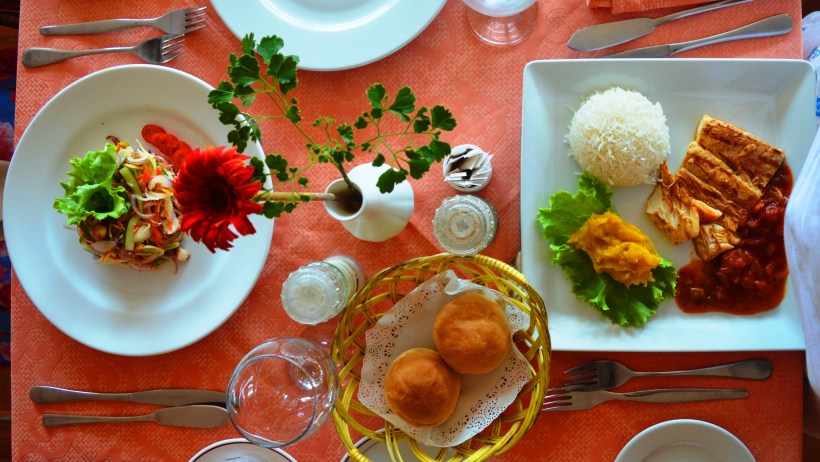
Britannia restaurant is well known for its culinary skills reflecting the pure Creole cuisine passed on from generations and traditions. It has managed to find a compromise between its convivial ambience, warm welcoming, and quality service of a renowned restaurant whilst maintaining a standard of a small “hotel de charme”. We had ordered Octopus salad and Smoked Job fish in Creole sauce. It was yum! After a very satisfactory fill of stomach we made our way towards Vallee de Mai.
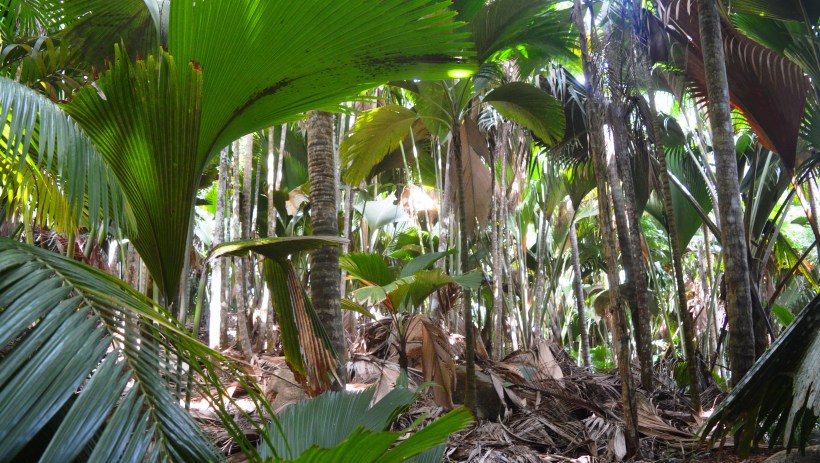
‘If you haven’t been to Vallee de Mai, your trip to Praslin is incomplete’, we were told so and now, after having spent a few hours at Vallee de Mai on the island of Praslin, we totally agree. There are some who believe that Vallee de Mai could be the original site of ‘Garden of Eden’. We really don’t know much about the authenticity of the statement, but we do know that a few hours amongst thousands of lush, green Coco de Mer palm trees will surely soothe your eyes and calm your mind.
Seychelles is home to two UNESCO world heritage sites – Vallee de Mai is one of them and Aldabra Atoll being the other one. Vallee de Mai is home to over 25% of the world’s Coco de Mer palm trees. The Coco de Mer is a primitive palm, endemic to the island of Praslin and a couple of islands around Praslin (including Curieuse Island). Nowhere else in the world can you find this wonder of the plant kingdom growing naturally. Besides the Coco de Mer palm, Vallee de Mer is home to five other endemic palm species – millionaire’s salad, thief palm, Seychelles stilt palm, latanier millepattes and latanier palm.
Vallee de Mer is home to not only primitive palms but also to the black parrot. The black parrot is found only on the island of Praslin, living and breeding in the presence of the Coco de Mer palm. While we were there, we heard mating calls of the parrots. The national park is home to many more colourful birds including the Seychelles blue pigeons, which are indeed very pretty and the Seychelles bulbuls, which are the loud, cacophonous and territorial. Let not the birdies take your attention off the ground and the trees, where you can spot the bright green coloured day gecko and the Seychelles snail.
There are three trails that can be used to explore Vallee de Mai… Cedar trail, Central trail and Circular trail. Most tourists end up doing only a part of the Central trail within an hour and head back with only a peek into the world of the Coco de Mer. However, to ensure that you have plenty of photo opportunities, soak in the atmosphere and spare some time for bird watching, we would suggest that you budget about 2 hours on the Cedar trail.
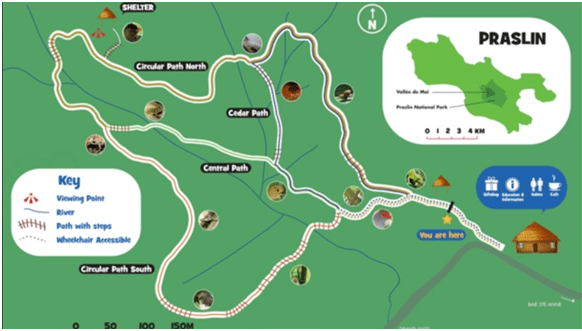
From Vallee de Mai we headed for Anse Lazio and Anse Boudin in the evening to view the mesmerising sunset, and then settled for the day with the prospect of exploring the most talked about beach in La Dique Island the next day.
Travel Pointers:
- Try to explore Petite Anse Kerlan & Anse Goergette at the time of sunset.
- Anse Georgette is a stunning beach framed by granite boulders and offer powder soft white sand. Access to this beach is obtained by special permission from Lemuria Resort. (Please note: the hotel sometimes limits the number of visitors, so call ahead and check to avoid disappointment). Another way to reach this beach is by doing a hike from Anse Lazio. The hike is through a rugged road, steep and narrow, moderately difficult. It takes about 30 minutes’ walk. Alternatively, it is also possible to reach Anse Georgette by boat, with some sailing tours stopping in this beautiful bay to enjoy the scenery.
- If you want to try some Creole food try Smoked Fish/ Octopus Salad as it is popular in this part of Seychelles.
- A Note on Vallee De Mai:
- Vallee de Mai can also be accessed using public transport i.e. the local bus service. The bus stop is just a few steps away from the entrance gate.
- The entrance costs EUR 20 and is payable in cash at the ticket counter. Most of this money is used to maintain both the world heritage site – Aldabra Atoll and Vallee de Mai. You are provided with a little pamphlet that has a map when you buy the ticket, which will help you determine which trail you would want to take.
- There are free guided tours provided by SIF (Seychelles Islands Foundation). It would be best to contact them a few days before you come to check the timing. We would highly recommend the guided tour.
- There is ample place to park your car. Just remember not to park under a coconut tree.
- The is a souvenir and coffee shop, which was very reasonable, much cheaper than any other souvenir shops that we ventured into. They sell Coco de Mer here which will cost a fortune. It costs around $ 300 USD. Just make sure that it has the government seal and comes with the export license. If it doesn’t have these things, you won’t be able to leave the country with it, and there’s a chance you could be fined or even sent to prison. Also, be sure to look for any aesthetic flaws.
- Wear comfortable footwear that lets you walk for a couple of hours. Use a mosquito repellent cream if you think you need it.
- Look carefully for birds and reptiles… they are usually well camouflaged.
- Seeds of Coco de Mer were found by sailors and pirates floating on waters of the Indian Ocean and they believed that the seeds were those of a mystical underwater tree. Thus, the name Coco de Mer was coined, which means ‘coconut of the sea’.
- Coco de Mer can grow up to a height of over 30 meters, almost as high as a ten-storey building. The palm has a frond of green leaves at its head with leaves as large as 4.5 meters.
- The life of a Coco de Mer is typically between 200 – 300 years!
- The male and female Coco de Mer tree are different. The palms take about 25 years to reach maturity. Until then, there is no way of distinguishing the male and the female tree. After they reach maturity, the difference is evident.
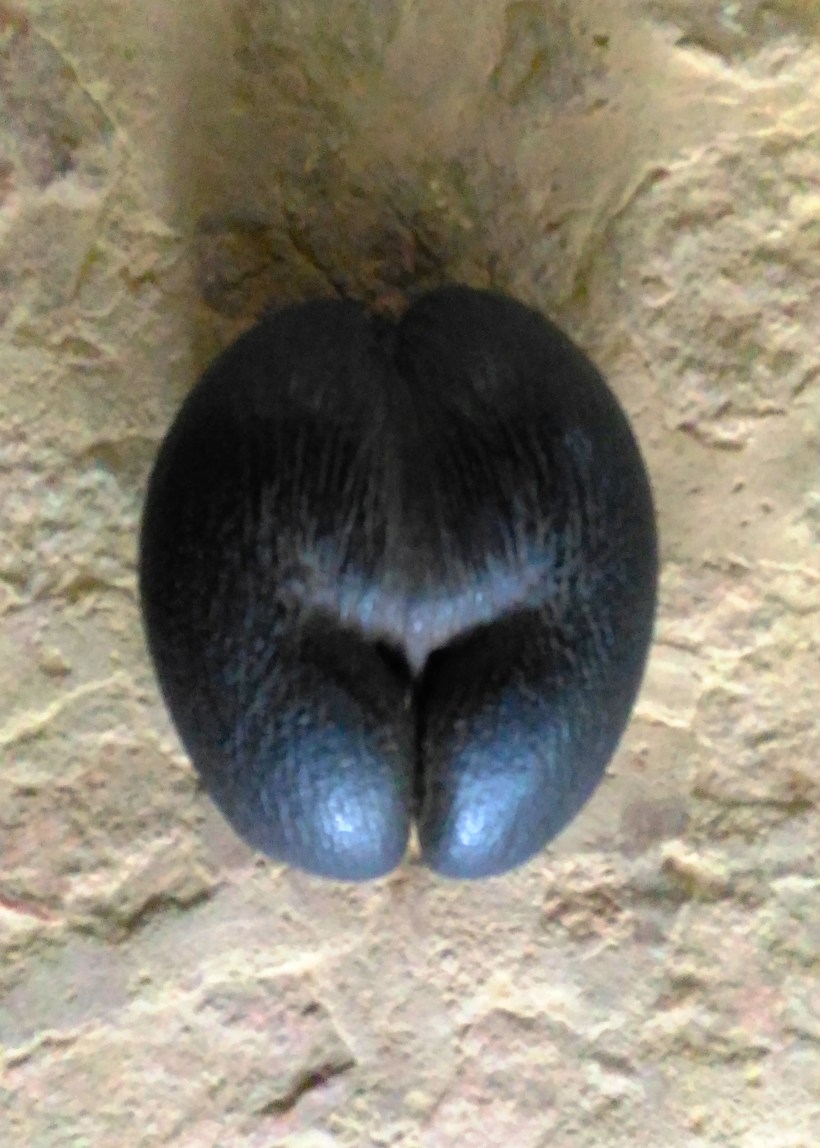
Female – Coco De Mer - The fruit of the Coco de Mer typically takes 6 -7 years to mature followed by 6 – 18 months required for germination.
- A female tree, at one time, can bear over 6 fruits, each weighing over 20 kgs. That sure is a lot of weight bear for any mom!
- The leaves at front join the trunk in a funnel shaped fashion, ensuring that all precipitation is collected and channelled to the roots of the Palm.
- The palm, regardless of the weight it carries, has some ability to twist and turn when the winds are strong. The trunk sits into bowl shaped structure that has hole to allow the roots to pass through, very similar to the ball and socket joint, which is held together by muscles.
- The juiciest bit is saved for the last! Coco de Mer seed is an aphrodisiac, though scientific studies are yet to confirm the same. Gossip magazines say that the fruit was offered to Prince William and Kate when they were in Seychelles!
 Outwards-n-Onwards